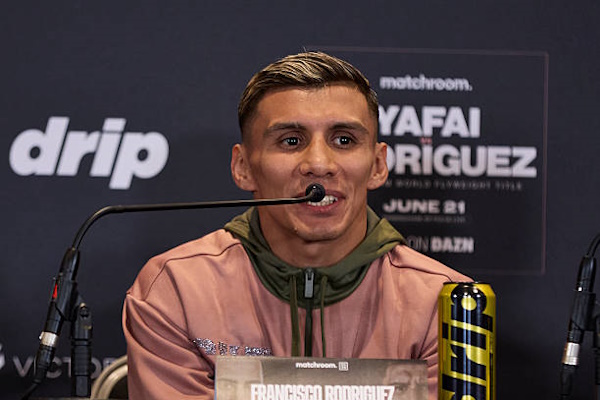

In just little less than a month, a second fighter may have tested positive for PEDs in Mexican WBC interim flyweight champion Francisco Rodriguez Jr. The fighter’s VADA test stems conducted following his June 21st bout win over British star Galal Yafai returned an adverse finding that puts Rodriguez’ tenure as the WBC interim flyweight champion in jeopardy.
After Jaime Munguia became the fourth Eddy Reynoso fighter to test positive for performance-enhancing drugs (PEDs), Francisco Rodriguez Jr. (40-6-1, 27 KO’s) has become the second notable Mexican fighter in just a month to return an “adverse finding” after being tested by the Voluntary Anti-Doping Association (VADA).
Rodriguez caused an upset on June 21st after defeating British flyweight Galal Yafai (9-1, 7 KO’s) by unanimous decision (UD) to become the WBC interim flyweight (112 lbs) champion.
Matchroom Boxing, the promoter of the June 21st show, revealed the adverse finding that occurred after both fighters’ drug samples were tested by VADA:
“Today, the Voluntary Anti-Doping Assocation informed Matchroom, the World Boxing Council and the British Boxing Board of Control that Francisco Rodriguez has returned an adverse analytical finding as part of a post-fight night anti-doping test following his bout with Galal Yafai on June 21st, 2025,” The UK-based promotion revealed earlier today.
Usually, an adverse finding denotes a ‘A-sample’ being detected to contain a substance that is considered illegal according to the World Anti-Doping Agency (WADA), though a B-sample ― derived from an identical urine or blood sample as the A-sample ― must first be tested to confirm Rodriguez’ PED use. B-samples are often taken alongside A-samples but are stored and sealed for purposes such as confirming the A-sample’s veracity.
The substance found within Rodriguez’ A-sample has not yet been revealed.
The British Boxing Board of Control (BBBofC) that was responsible for regulating the entire June 21st card will be involved within the process regarding Rodriguez’ anti-doping violation, while the WBC is also set to take action by stripping the Mexican interim champion of his belt ― though neither organizations are expected to make any official decisions until Rodriguez’ B-sample confirms the adverse finding wasn’t just an anomaly.
As per the usual standards, the June 21st result between Yafai and Rodriguez will only be overturned once the BBBofC has formally charged Rodriguez with violating their anti-doping rules ― which could take a matter of months given the testing of the B-samples and the subsequent last-ditch hearing that Rodriguez is allowed to prove his innocence.
Based on prior examples of fighters that tested positive for PEDs under the BBBofC’s jurisdiction, Rodriguez potentially faces a two-year ban ― a more stringent sentence as opposed to fighters that fail drug tests under the United States’ jurisdiction who appear to receive a maximum of a one-year suspension.