
The recently reported attempts by the U.S. Congress to amend the Muhammad Ali Act has begun facing opposition.
Patrick English, a lawyer who was involved in the creation of the Ali Act has come out and heavily criticized the recent “Muhammad Ali American Boxing Revival Act” bill introduced by representatives Brian Jack and Sharice Davids which is attempting to create Universal Boxing Organizations (UBOs) that allows it to supersede several restrictions put in place.
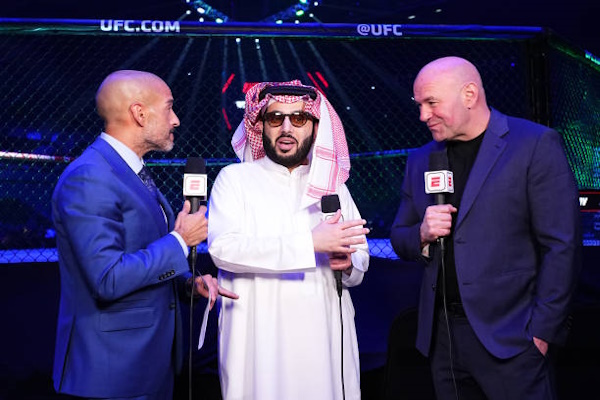
One of the most notable feature of the proposed bill aims for UBOs to be able to perform their own drug-testing methods; something currently already applied by the UFC. Notably, the UFC’s chairman Dana White appears to be a strong proponent of this bill based on prior statements where he championed for a league to be created; a format that will be able to come to fruition through the Ali Revival Act.
As the bill denotes, a UBO would be able to create its own titles, wage structures and further blend between the roles of a promoter and manager ― despite the original Ali Act having been designed around disallowing a promoter to serve as a manager, thereby effectively allowing for a league structure to be formed.
In essence, the Revival Act allows the UBO to function as sanctioning body, a promoter and manager to retain full control over a fighter’s career with fewer means for the fighter to combat decisions made by the UBO, such as ranking positions.
According to English, the proposed Revival Act aims to put power into the hands of a single promotion, suspected to involve the jointly-created promotion by Dana White and Turki Alalshikh, Zuffa Boxing, which directly contradicts the reason the bill was initially drafted by former 2008 presidential candidate John McCain:
“As an individual who was heavily involved in the drafting of the Professional Boxer Health and Safety Act and the Muhammad Ali Act and who has an extensive boxing resume I feel that I am uniquely qualified to comment on the proposed amendments to the Acts,” English’s article on the Revival Act reads.
“When John McCain and his staff drafted the Acts there was no agenda but one. That Agenda was to make boxing better, safer, and more fair to boxers. There was no intent at all to favor any single promotional entity. That is not the case here. The clear intent is to favor a single promotional entity. The bill was substantially drafted by lobbyists for that entity, to wit Zuffa and its various subdivisions.
“The bill does something that McCain expressly disavowed. There had been a history of coziness between certain promoters and ratings organizations. For background on this read Jack Newfield’s book, “Only in America: The Life and Crimes of Don King” and read about the indictment and ultimate conviction od Bob Lee, then the IBF President. The Act was intended to create, among other things, a firewall between ratings organizations and Promoters. The proposed amendment destroys that firewall as to a selected entity which will be awarding in house championships based upon ratings which excludes boxers not affiliated with that entity. This is a betrayal of the current act and of what McCain and those who worked with him were trying to accomplish.“
Patrick English further delineated that a UBO, in its function as a sanctioning body, promoter and manager all rolled in one, would curtail several rights meant to protect a fighter including:
- the ability for a fighter to legally combat a ranking unlike with the current sanctioning bodies
- a requirement for fighters in all title bouts to be tested
- the ability to negotiate for pre-bout drug testing unlike the current state of boxing where fighters can request VADA testing prior to fights
- a requirement for a UBO to explain their rankings
- the reporting of positive drug test results to either a promotion or the Association of Boxing Commissions (ABC), a discrete adaptation from the original rule that forces anti-doping violations to be forwarded to both
Other points made by English suggests the bill is far more ominous than it is being construed by, with the Revival Act notably vague on what fighters can be tested for. According to English, while the Revival Act construes itself as being a champion for improving drug tests, it does not actually clarify whether it will adhere to the World Anti Doping Agency’s (WADA) testing standards for prohibited substances.
Essentially, this means that the Revival Act could facilitate the use of doping rather than prevent it, adding on top of what appears to be a bill with malicious intentions while ironically framed as something positive for the sport.
Acknowledging that the original Ali Act still has several wrinkles that need to be addressed, English unequivocally questioned the legitimacy of the changes proposed in the Revival Act in the conclusion of his article:
“I do not pretend that the Ali Act or the Professional Boxer Health and Safety Act is perfect,” English’s closing statement reads.
“There is room for improvement. However the proposed Amendment is not the way to go. It lessens protections for boxers and is designed for a single purpose – to allow the new Zuffa boxing entity to avoid restrictions designed to protect boxers. This is an ignoble goal.“
One of the key events that occurred that further aroused suspicion was ABC chairman Mike Mazulli’s assertions of having no information on White’s plans in regards to boxing. This changed once the Revival Act was introduced, with the ABC now set to play a prominent role as it pertains to the reporting of positive drug tests.
The Revival Act also remains vague on what a UBO is, with there being plenty of indications that any promotion tied to a UBO will actually function as a UBO ― giving the recently-formed Zuffa Boxing the perfect means to function similar to the UFC which is a centralized MMA promotion that is conveniently already functioning as a promoter, sanctioning body and manager.