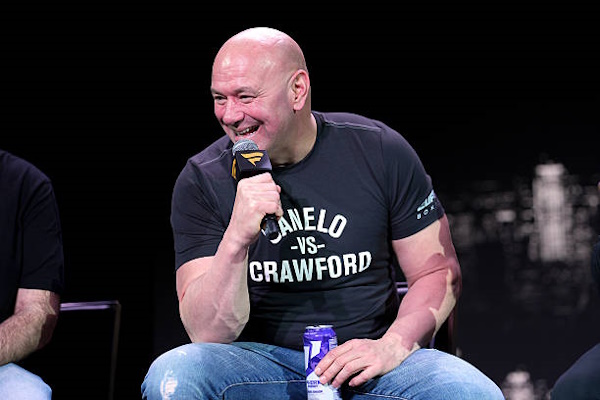

Dana White and Turki Alalshikh are one step closer towards their shared goal of cornering boxing after a bipartisan bill was introduced within the US congress. With the US congress apparently having a say over how boxing is run yet remaining notably absent in regulating it, congress is now planning to update the Muhammad Ali Act that aims to allow White and Alalshikh to form a boxing league that aims to topple the entire structure of sanctioning bodies and promoters.
The current bill that has been introduced into congress by representatives Brian Jack and Sharice Davids, a former MMA professional, on Wednesday, July 23, will alter the “Muhammad Ali Boxing Reform Act” and allow certain limitations to be discarded or adapted to suit the needs of Dana White and Turki Alalshikh’s boxing promotion. The bill has been branded as the “The Muhammad Ali American Boxing Revival Act”.
Though White initially denied planning to create a league, the recent bill actually does appear to allow its formation in all but name as the details that have come forth that will change the entire structure of the sport.
The aim is to do this not through an actual promotion or league but by creating an alternative through the “Unified Boxing Organizations” (UBOs) system that will enable White and Alalshikh’s “TKO Boxing” venture to create and control its own titles, create its own pay structures and decide its own rankings. Currently, only the four main sanctioning bodies [WBA, WBC, WBO & IBF] have a say in these matters.
The benefits that are included in the “revival” bill are certain health insurances that aim to cover a fighter’s injuries sustained during training or bouts, as well as provide more safety and health measures for fighters including the availability of more [and proposedly better] medical professionals, and more thorough medical exams.
It should be noted that there is a difference between what the bill proposes, and what certain details actually means. In a sport where corruption has feasted for decades, certain plans that the bill aims to introduce contradict the actual goal of the Ali Act which was created to provide fair opportunities to fighters and prevent them from being taken advantage.
This includes PED-testing which the bill states will allow UBOs to conduct their own “comprehensive anti-doping testing programs”, which could be another way for UBOs to actually facilitate doping by excluding WADA-approved anti-doping tests conducted by organizations such as VADA.
Other advantages that the bill proposes are related to anti-betting measures and the absence of any sanctioning fees for top-rated contenders or beltholders ― unlike the current structure created by the sanctioning bodies where even interim champions and beltholders of lesser titles are still required to pay sanctioning fees. Fighters, at least with the WBC, are also required to pay a low percentage [of 3%] to be able to participate in elimination bouts.
The bill claims the UBOs will not exclude the other sanctioning bodies but given White’s own stated plans of doing exactly that, it appears the introduction of the bill is part of a more comprehensive plan by White and Alalshikh to take over boxing. Whether White and Alalshikh’s TKO Boxing [or the most recent-assumed brand name of Zuffa Boxing] will distinguish itself as an UBO or merely be part of its system, the introduction of the legislation is no coincidence after the WBO first raised concerns regarding attempts by White to alter the Muhammad Ali Act through congress.
Aligned with US President Donald Trump, Republican representative Brian Jack’s decision to introduce the bill alongside former MMA professional Sharice Davids further appears to align perfectly with what White and Alalshikh have been aiming for since the start of the announcement of their promotion/league.
Without the express efforts of both Jack and Davids, the joint venture between Dana White and Turki Alalshikh would not have been capable of being anything more than a new promotion on the block, but through the proposal of the UBOs can now gain a substantial footing in the sport that basically gives it the means to do what they want, from creating their own titles and weight classes while still able to take up the same promotional duties as other boxing promotions.
In this manner, the Muhammad Ali Act, which prohibits promoters from acting as a fighter’s manager amongst other safeguards, will now see any company linked to the UBO model able to function as both a promoter and a manager.
The bill is further supported by Muhammad Ali’s widow, Lonnie Ali, which appears to be a clear attempt to legitimize the formation of the UBOs that actually threaten the original premise [which imposes limitations on stakeholders aiming to take advantage of fighters] it was built upon.
Moreover, the Association of Boxing Commission (ABC) is also reportedly fully in support of the bill ― roughly two months after its chairman, Mike Mazulli, revealed to have few to no details on White’s actual plans in regards to the Ali Act.
Though some of the proposed benefits appear groundbreakingly positive for fighters, with claims made that emphasize “better health and safety protections, greater compensation, and more choice and opportunities” for fighters that are a part of this UBO model, there are still multiple concerns left unaddressed.
Plans to spike the pay of fighters, by instituting a minimum made per round, did not substantiate on the maximum a fighter would be allowed to earn; with the current boxing structure allowing managers to negotiate beneficial arrangements such as fighters receiving the proceeds of PPV events. It is unknown if this same structure will be allowed to persist, but what is a common in the UFC ― that’s run by chairman Dana White ― is the inability to negotiate revenue share and other such financial benefits.
As the bill seems to indicate any company under the UBO structure will be able to decide on their own pay structure and contract terms, the Muhammad Revival Act could actually stifle fighters under the UBO system from making more money.
The health benefits itself seem limited and seems to focus mainly on injuries that can be sustained without mention of pension-related expenses for retired fighters ― something that is arguably more important given the long-term brain damage that can be developed from a boxing career.
Outside of these details, the UBO system does largely appear to be able to provide young and talented fighters with the ability to break through based on their performances and accomplishments ― so to speak by spreading a wide net to attract fighters globally that aren’t linked to the well-known promotions in boxing.
Notably, the UFC model has shown a proclivity in discarding fighters that do not perform to their standards or have even criticized the UFC in some shape or form. This could potentially backfire for the UBO system as fighters could make their name in the sport and go on to fight under traditional promotions where there would be higher thresholds for earnings and more freedom in deciding their careers.
Other boxing promotions do not appear to be under any real threat as of yet, especially given the joint White and Alalshikh promotion/league will fall under the UBO system once approved. Given the UFC adopts a pay-per-view (PPV) broadcasting model, TKO/Zuffa Boxing would rationally-speaking adopt the same which would force it compete against streaming service DAZN.
DAZN recently announced plans to abandon the PPV structure for The Ring and Riyadh Season cards starting November, making them tougher to compete against for TKO/Zuffa Boxing who would further need to develop mostly unknown fighters into household names from the ground up.