The WBC unsurprisingly fulfilled their role as the worst sanctioning in the body to deem Francisco Rodriguez Jr. innocent of intentional PED-use. Notably, the WBC has ‘cleared’ Rodriguez of intentional doping as they conducted their own investigation. Despite this, the WBC, who notably has no authority to clear or ban any fighter for PED use, has declared Rodriguez Jr. innocent which seems to have been accepted by the clearly inept governing body of the BBBofC.
The fact that WBC has no authority to clear or ban any fighter for drug use was something has been clearly illustrated in their rules which delineates the exact authority the sanctioning body has and limits them to only handing out punishments or clearances based on their own organization:
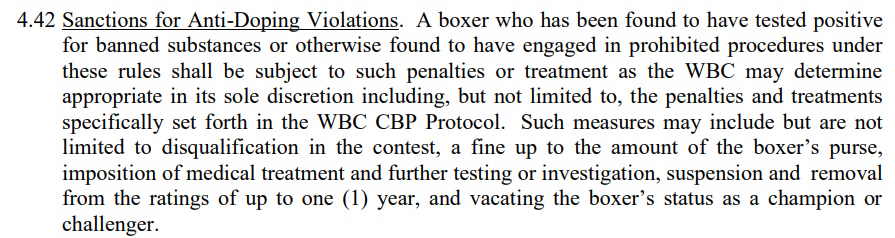
While the sanctioning body retains the authority to remove a fighter from their rankings, prevent certain fights from happening if it involves a WBC title or strip champions of their titles, it also retains the ability to dismiss these same violations to a point.
In the case of Francisco Rodriguez Jr (40-6-1, 24 KO’s) who failed a PED test ― construed as an ‘adverse finding’ being found after a VADA test was administered ― for his June 21st win over Galal Yafai (9-1, 7 KO’s), the WBC has ruled the Mexican fighter to have unintentionally used an illegal substance after conducting their own investigation:
“Mr. Rodriguez ingestion of a banned substance(s) was accidental, unintentional, unknowing, and not directed to enhance his performance,” The WBC claimed in their official press release regarding their ruling.
“The WBC shall declare vacant Champion Rodriguez’ interim title and reinstate Galal Yafai as the reigning WBC Interim World Flyweight Champion and order a direct rematch between Yafai and Rodríguez.“
Further setting a probationary period of 12 months for Rodriguez while declaring the Yafai-Rodriguez fight a no-contest ― something they do not actually have the authority to do, there are multiple actions the WBC has taken that do not fall under their jurisdiction.
In fact, this is something the WBC admitted to in their own press release as they went on to explicitly request the British Boxing Board of Control (BBBofC) to change the result to a no-contest.
“The WBC shall change the outcome of Rodriguez v. Yafai June 21, 2025, bout to No Contest in the WBC records. The WBC is hereby making a request to the British Boxing Board of Control, as the authority which oversaw that bout, to change the result of that bout to a no-contest as well,” The WBC further stated.
The very mention of the BBBofC highlights how the WBC in fact has no authority to decide whether a fighter is innocent or guilty. Only a governing body, such as the BBBofC or a state athletic commission like the New York State Athletic Commission (NYSAC) decides whether a fighter violated their anti-doping rules or not if that athlete competed on a card they held jurisdiction over.
As it pertains to Rodriguez’ June 21st fight against Galal Yafai, the BBBofC is liable for handling Rodriguez’ PED case regardless of where his license falls under.
Yet the BBBofC’s authority seems to have been flagrantly ignored by the WBC who previously have imposed similar rulings on fighters that do not fall under their jurisdiction; with Conor Benn most notably having been ‘cleared’ by the WBC of intentional PED-use. Of course, this clearance was not met with any strict seriousness as the BBBofC and UK-Anti Doping (UKAD) went on to involve themselves in a case spanning for two years where they tried [and failed] to hold Benn accountable. Benn was eventually cleared [for the second time] by the NADP under circumstances which offered little clarification as to the exact reasons for his exoneration.
The Benn case illustrates the WBC’s inefficiency at conducting their own investigation, making their own assessment of Rodriguez’ situation dubious at best, and thus removing any sense of legitimacy regarding this process that has seen the Mexican fighter become vindicated due to what the WBC claims is the unintentional use of illegal substances.
The BBBofC still retains full authority to decide whether Rodriguez violated the anti-doping rules or not, though no news has yet arrived on their case with Rodriguez since he failed his VADA test last month ― with a mention of what Rodriguez tested positive for and whether his B-sample will be tested having remained absent thus far.
Regardless of the WBC’s reasons or evidence for exonerating Rodriguez, this decision remains solely in the hands of the BBBofC, and while the WBC is allowed to order a rematch and reinstate Rodriguez as an interim champion, it is the BBBofC who retains the authority to decide whether the Mexican fighter is banned or not.
Even worse, the circumstances of the WBC’s decision to clear Rodriguez comes off the back of revelations that Rodriguez also failed a drug test in the fight prior to facing Yafai, according to Matchroom chairman and Yafai’s promoter Eddie Hearn:
“I was just on BoxRec last night looking at Francesco Rodriguez, and I saw that his last fight was a no-contest,” Hearn told iFL TV.
“Now, normally if there’s a ban, it will tell you on BoxRec, but obviously if there was a ban this is now, and because of what’s happening, [I started] to look a little deeper into this and it says no-contest.
“So, we speak to the Texas Commission who confirmed that he [Rodriguez] failed a drug test on the night [of December 15, 2025]. Now we’ve requested more information on that. I then phoned [WBC president] Mauricio Sulaiman and said, ‘Did you know that Francisco Rodriguez also failed a drug test for his last fight?’. And he said, ‘No, I didn’t’.“
Rodriguez’ sudden no-contest ruling by Texas’ boxing commission, the Combative Sports branch of the Texas Department of Licensing and Regulation (TDLR), widely went unreported due to the commission’s tendency to refuse to be transparent ― similar to the circumstances surrounding the clearance of British heavyweight Dillian Whyte who apparently proved his innocence to the commission.
The no-contest pertains to a fight Francisco Rodriguez had on December 15th last year against American Josue Jesus Morales who was defeated by Rodriguez through unanimous decision (UD) in the 8th round.
The fact that Rodriguez failed a drug test stemming from his fight in December should have seen the fighter already suspended and ineligible to even compete against Yafai, yet conveniently this entire matter was obscured by Texas’ boxing commission who only seemed to overturn Rodriguez’ December bout without any notable repercussions.
The entire case goes shows the true corruptive nature of the sport of boxing, with Francisco Rodriguez apparently failing two drug tests in a row only for the WBC to place him back as an interim champion and order a rematch with Galal Yafai which only further signifies how Rodriguez has been blatantly allowed to continue to fight without any sort of repercussions.
In the meantime, the BBBofC has become the last line of defense against the fight against anti-doping as they are expected to make a decision surrounding Francisco Rodriguez which will hopefully see his case handled appropriately under the law and jurisdiction of the British governing body.
Texas’ boxing commission further needs to be investigated, with the latest case surrounding Rodriguez and the lack of suspension that should have been enforced globally now placing the TDLR under heavy scrutiny and signifying a complete lack of suitability for regulating combat fights.
However, as is often the case in boxing, with no actual body in place that can mete out punishments to fighters globally for anti-doping transgressions and this being limited to governing bodies such as Texas’ incompetent boxing commission, boxing continues to be a “Wild West” industry where fighters can fail drug tests on two occasions and still be allowed to compete.
The entire state athletic commission system also proves to be flawed. In the case of the BBBofC who regulates all boxing in the UK, this is far from the case in the United States where combat fights are regulated per state who have their own governing bodies overseeing everything ― which has clearly culminated in an inefficient system that has allowed fighters like Rodriguez to slip through the cracks of what should have clearly been at least a one-year suspension.